
🧬🧠 BEYOND PATHOLOGY
What If Being Extremely Flexible AND Neurodivergent Isn’t Automatically a Bug?
You know that moment when medicine looks at something unusual about your body and immediately reaches for a diagnostic checklist?
🩺 “Your joints bend how far?”
📝 “Okay… let’s investigate.”
And then your brain joins the conversation:
🧠 “Oh, and I also process the world differently.”
Medical system:
🚨 SOMETHING IS WRONG WITH THIS HUMAN.
Meanwhile, the human:
🤸 “Mate… I’m fine. I can touch my toes without bending my knees and I haven’t dislocated anything since… ever.”
😂
And this is where things get genuinely interesting.
🦴 THE HYPERMOBILITY QUESTION
Being extremely flexible doesn’t automatically mean you have Ehlers-Danlos syndrome or another connective-tissue disorder.
Some people are simply very flexible.
Some have generalised joint hypermobility without significant symptoms.
Others have hypermobility associated with conditions such as Hypermobility Spectrum Disorder (HSD) or certain forms of Ehlers-Danlos syndrome (EDS).
Those are not interchangeable.
And this distinction matters.
Because there is a rather enormous difference between:
🦴 “My joints have an unusually large range of motion.”
and
🚨 “My connective tissue has a recognised pathological disorder.”
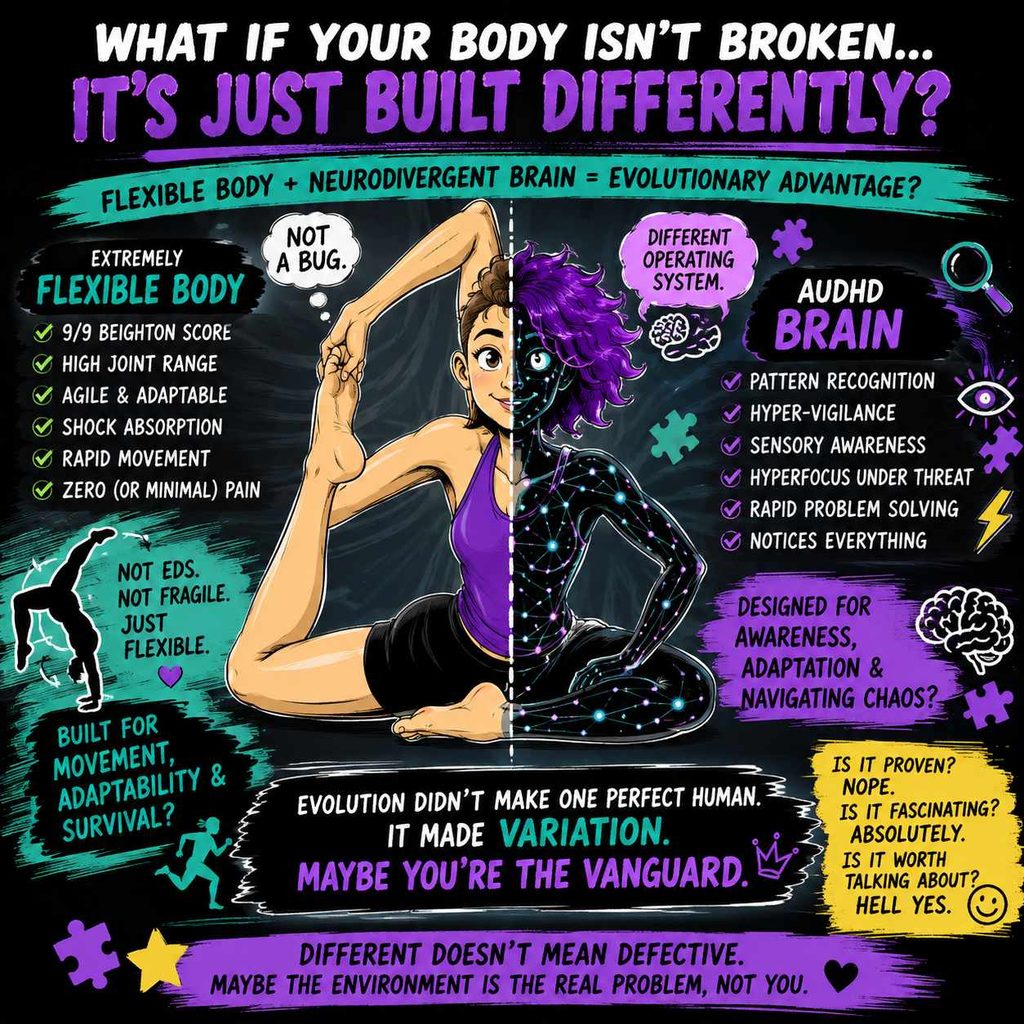
A 9/9 Beighton score tells us that someone is very flexible.
It does not, by itself, tell us why.
And it certainly doesn’t diagnose EDS.
🤸 SO WHY ARE SOME PEOPLE EXTREMELY FLEXIBLE… AND COMPLETELY FINE?
This is where things get fascinating.
Human bodies aren’t manufactured from one standard blueprint.
Genetics, development, anatomy, muscle control, connective tissue properties and environmental factors all contribute to how flexible someone becomes.
Some people have naturally:
🔹 Greater joint range
🔹 Different joint geometry
🔹 More elastic soft tissues
🔹 Different muscle-control strategies
🔹 Greater movement adaptability
…and yet remain strong, coordinated and completely functional.
Think of it as the difference between:
🧱 “Built like a brick.”
and
🪢 “Built like a very competent bungee cord.”
Neither automatically means the building inspector needs to be called.
😂
🧠 NOW ADD A NEURODIVERGENT BRAIN…
Here’s where the hypothesis gets particularly interesting.
Some autistic and/or ADHD people describe:
👀 noticing tiny environmental changes
🔍 spotting patterns other people overlook
🎯 intense periods of concentration
⚡ rapid responses when something suddenly becomes interesting or urgent
🧠 constantly scanning their surroundings
🏃 needing movement rather than sitting still
🎧 unusually intense sensory experiences
And when you combine those characteristics with an unusually flexible body…
…it is tempting to imagine a rather interesting human operating system.
But there’s an important BIG FAT DISCLAIMER here:
🚨 We don’t currently have good scientific evidence proving that AuDHD + hypermobility is an evolved “vanguard” phenotype.
That’s an intriguing hypothesis, not an established evolutionary conclusion.
And honestly?
That’s what makes it fun.
Because we’re allowed to ask the question without pretending we’ve already solved it.
🏹 THE “VANGUARD” HYPOTHESIS
Imagine prehistoric humans.
Not everybody needed to do the same job.
One person might have been brilliant at:
🌾 repetitive work
🛖 maintaining routines
🪵 building
📦 organising resources
While another might have been the person who constantly noticed:
👂 “Did you hear that?”
👀 “Something moved over there.”
🌿 “Those plants weren’t like that yesterday.”
🐾 “There are tracks here.”
🌩️ “The weather is changing.”
🔥 “Something’s wrong.”
That second person might have been incredibly annoying at dinner.
😂
But potentially very useful when something unexpected happened.
This is basically the idea behind the specialisation hypothesis:
A trait doesn’t necessarily need to be advantageous for everybody to remain in a population.
Different people can be good at different things.
Humanity doesn’t need 100 identical humans.
Thankfully.
Can you imagine the meetings?
😂
🧠 THE NEURODIVERGENT ADVANTAGE?
Some characteristics associated with autism and ADHD can be genuinely useful in the right environment.
🔎 Pattern recognition
Autistic people can sometimes demonstrate strong attention to detail and pattern-based thinking.
Useful for:
🧩 complex systems
🔬 analysis
🎨 specialised interests
💻 technology
🕵️ noticing inconsistencies
⚡ ADHD & novelty
ADHD isn’t simply “can’t concentrate.”
It’s considerably more complicated.
Interest, novelty, urgency and reward can dramatically influence attention.
Which means:
😴 “Please sit through this three-hour meeting.”
Brain:
Absolutely not.
🚨 “Something unexpected is happening!”
Brain:
EVERYONE STAND BACK. I HAVE ARRIVED.
😂
👁️ Sensory awareness
Some neurodivergent people experience sensory information unusually intensely.
That can be exhausting.
But heightened awareness isn’t automatically useless.
The same system that notices:
🔊 the tiny irritating buzzing sound
might also notice:
👂 something changing in the environment.
The problem is that modern life contains approximately 47 billion irritating buzzing sounds.
🤸 AND THEN THERE’S THE FLEXIBILITY
Now add a body capable of moving through an unusually large range of motion.
Potentially useful for:
🧗 climbing
🏃 changing direction
🤸 unusual movement patterns
🥋 certain physical activities
🧘 body-position awareness
🪂 absorbing awkward movements
But again:
Potentially useful ≠ proven evolutionary adaptation.
Some hypermobile people are exceptionally athletic.
Others struggle with instability, fatigue or pain.
And some are simply…
🤸 “Yeah, I’m ridiculously bendy.”
…and carry on with their lives.
🏢 THEN WE PUT THIS HUMAN IN AN OFFICE
And here’s where evolutionary mismatch becomes an interesting concept.
Imagine a nervous system that likes:
🌳 movement
👀 environmental information
🔄 variation
🎯 meaningful challenges
🧠 stimulation
Then we put it into:
💡 fluorescent lighting
🪑 one chair
🖥️ one screen
⏰ exactly the same schedule
🤐 “Please don’t move.”
🕘 “Please concentrate for eight hours.”
📊 “This meeting could have been an email.”
Brain:
I HAVE MADE MY OBJECTION CLEAR.
😂
For someone with hypermobility, prolonged static positions may also place extra demands on muscles that are working to stabilise joints.
So suddenly:
🪑 “Just sit normally.”
isn’t necessarily as simple as it sounds.
⚠️ BUT LET’S NOT ROMANTICISE IT
This part is important.
Being neurodivergent isn’t automatically a superpower.
Hypermobility isn’t automatically an evolutionary advantage.
And combining the two doesn’t magically produce:
🦸 THE ULTIMATE HUMAN
😂
Some people experience significant disability.
Some experience pain.
Some experience fatigue.
Some experience sensory overload.
Some have genuine connective-tissue disorders requiring medical care.
And some people have the combination without major physical problems.
Human biology is messy.
Very messy.
There isn’t always a neat little box.
🧬 SO… ARE WE LOOKING AT A DIFFERENT KIND OF HUMAN?
Probably not a separate “type of human.”
But perhaps we’re looking at something much more ordinary and much more interesting:
Human variation.
Evolution doesn’t produce one perfect design.
It produces variation.
Some bodies are tall.
Some short.
Some incredibly strong.
Some exceptionally flexible.
Some brains thrive on routine.
Others thrive on novelty.
Some people notice details.
Others see the big picture.
Some people are brilliant at social navigation.
Others are brilliant at systems, patterns or specialised knowledge.
And occasionally…
you get someone who is:
🤸 ridiculously flexible
🧠 wildly neurodivergent
👀 notices absolutely EVERYTHING
⚡ runs on chaos
…and somehow survives adulthood.
😂
🧠 THE REAL QUESTION
Instead of immediately asking:
“What’s wrong with this person?”
perhaps sometimes we should also ask:
“What kind of environment does this person function best in?”
Because a trait can be disabling in one environment…
…and extremely useful in another.
A nervous system overwhelmed by an office might thrive outdoors.
A person who struggles with repetitive tasks might become phenomenal when solving novel problems.
Someone who can’t sit still through a meaningless conversation might sit perfectly still for four hours while completely absorbed in something they care about.
Sound familiar?
👀
Exactly.
🌍 SA-BUZZ TAKEAWAY
We don’t need to pretend every unusual trait is an evolutionary superpower.
We also don’t need to assume every unusual trait is a defect.
Sometimes biology is simply…
different.
And sometimes the problem isn’t the human.
Sometimes it’s the environment demanding that every human operate exactly the same way.
🧠 Different brain.
🦴 Different body.
🌍 Same planet.
And maybe the most interesting question isn’t:
“How do we make everyone normal?”
It’s:
“What happens when we build environments where different kinds of humans can actually thrive?” 🧠🧬🌈
🔬 ONE LAST REALITY CHECK
The idea that AuDHD + hypermobility represents a specialised evolutionary “vanguard” phenotype is currently speculative.
There are interesting research connections between neurodevelopmental traits and hypermobility, but that is very different from proving that evolution specifically selected this combination for scouting, survival or agility.
So we’ll happily put the hypothesis on the table…
🧠 Interesting? Absolutely.
🔬 Proven? Not yet.
🤔 Worth researching? Definitely.
And that, ladies and gentlemen, is how science works.
You get an interesting idea…
…and then spend the next 20 years trying to prove whether your brain was being brilliant or just wildly enthusiastic